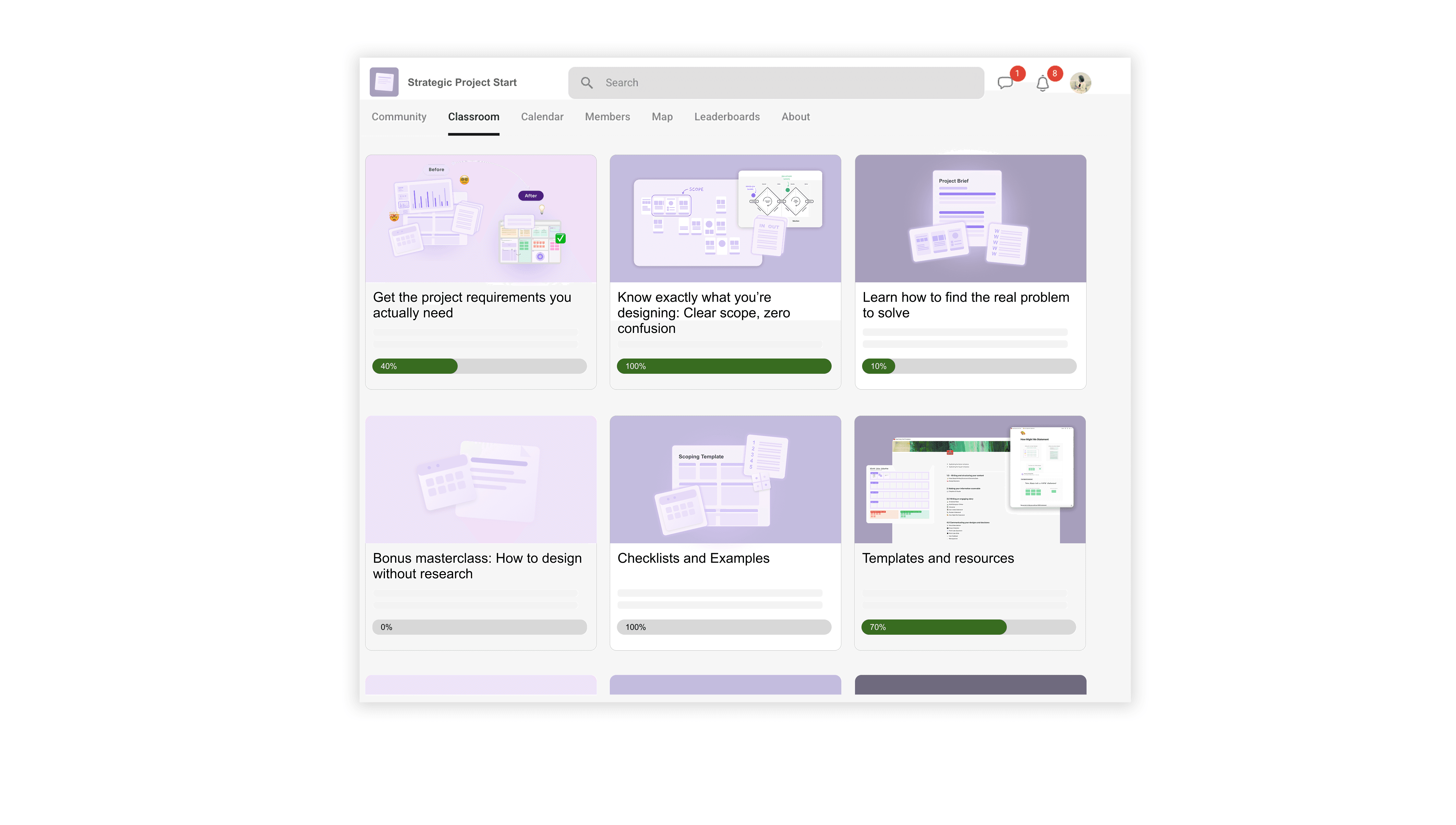
Finally know how to confidently start your design projects

STRATEGIC PROJECT STARTs

STRATEGIC PROJECT STARTs

In just a few days, implement the Strategic Project Start methods to start each project clear on what to do, without uncertainty, so you can confidently lead your work.

Finally know how to confidently start your design projects

STRATEGIC PROJECT STARTs

In just a few days, implement the Strategic Project Start methods to start each project clear on what to do, without uncertainty, so you can confidently lead your work.

When you start your projects wrong, everything downstream becomes harder…

I used to dread the start of every design project.


My PM would slack me: "Can you design [vague thing]?" and I'd feel this wave of anxiety wash over me.

I'd open Figma and just... stare at the blank canvas. I didn't know what problem I was solving. I didn't know what success looked like. I didn't even know which screens I was supposed to design.

I had no idea where to start.

I would fumble my way through the project, jumping between random design tools and frameworks, without really understanding why, and hoping that something would work.

I did competitor research on almost every project (80% of the time it wasn’t needed) just to feel like I was moving forward 😂

And when it came to coming up with ideas, each decision almost felt like a shot in the dark because this was my reality:

  • I was handed weak briefs, with vague goals or snippets from strategy decks.

  • I felt overwhelmed by ambiguity, never knowing if I had enough information to start designing.

  • I didn’t know where to begin or what questions to ask.

  • Stakeholders dictated solutions, and I didn’t know how to push back strategically.

  • I constantly second-guessed the problem, because I didn’t have any research.

  • Basically I didn't really know what I was aiming for or what direction to go in with my ideas. 

I had no idea what leading a project actually looked like.

But then I moved to my next company, and everything changed.

I started working with four incredible super IC designers, and I spent the next few months just... watching them (in a non creepy way 😂).


What I observed really surprised me.
They'd spend the first weeks of a project not designing at all. Instead, they were having conversations with the team, asking questions, running workshops, covering walls in post-it notes.

Honestly, I thought they were overthinking it.

But then they'd present their concepts, and suddenly everything made sense. They'd taken all the messy project context and distilled it down into one clear problem statement and they confidently and clearly explained exactly what the problem was and exactly how they proposed to solve it. 

Meanwhile, I was sat at my desk on my third round of wire-framing random ideas, hoping someone would tell me which one was the best to move forward with 🫠

That's when it hit me:

I'd been skipping the most important step. Creating clarity before designing anything.

So I decided to shadow all 4 designers, noting every question they asked in kickoffs, reverse-engineering their briefs, analyzing their FigJam workshops, asking all the ‘dumb’ questions.

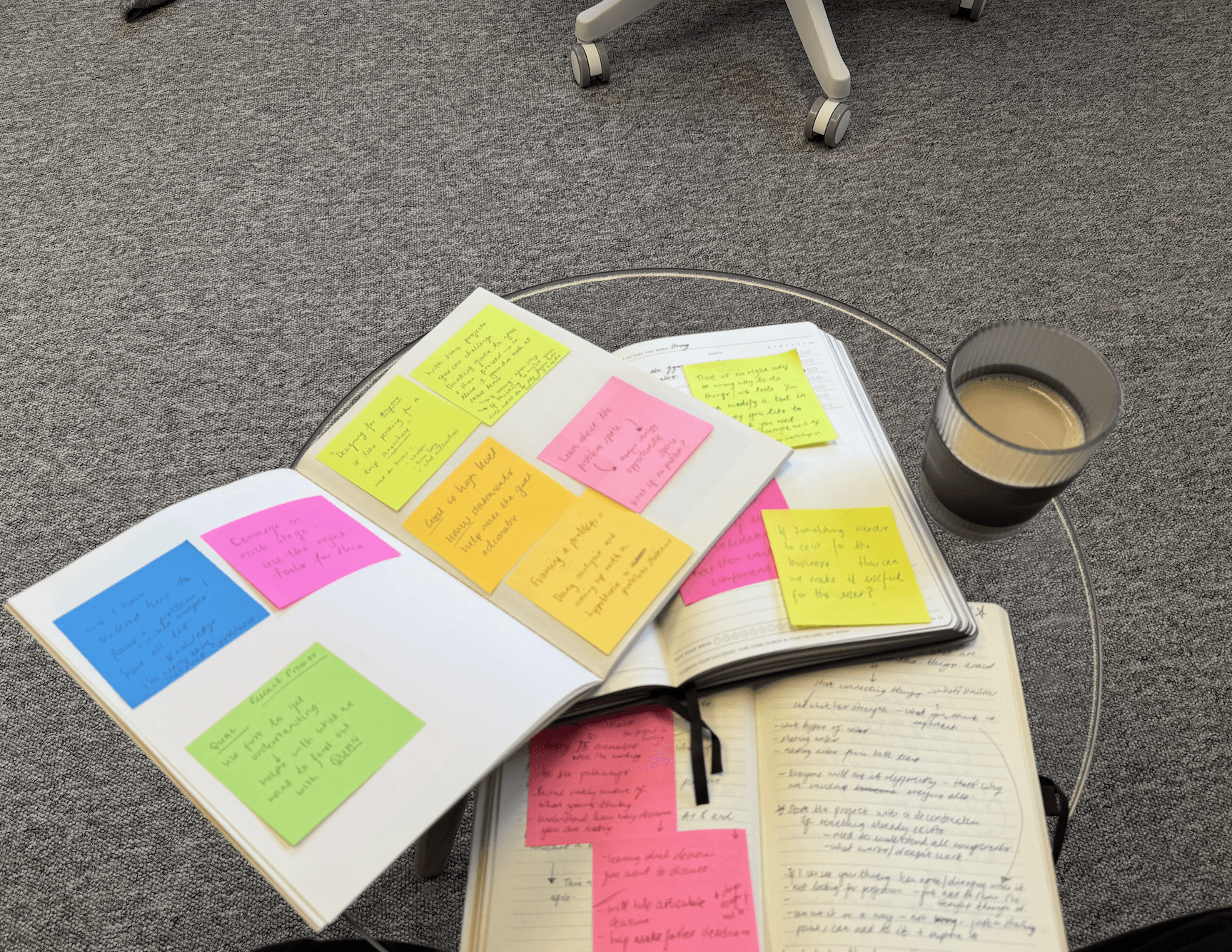
I kid you not, I documented and make notes on absolutely everything they were doing and saying (probably borderline creepy at this point). I had notebooks full of notes, pages and pages of the expert knowledge I couldn’t find in design articles or YouTube videos. Knowledge that took me months of trial and error to actually implement and fully understand whilst having access to these amazing designers! 

(I still have all the notebooks from over 6 years ago, here's 3 of them, every now and then I have a browse through 😅)
A few months later, I got a new project and pushed myself to try something different: spend the first week not designing, just getting clarity. I applied many of the tools and approaches I had learned.

It felt almost like wasting time, I kept wanting to just open Figma and start.

But when I finally did open Figma, I knew exactly what to design and why.

Suddenly, designing and making decisions felt clearer than ever.  

I no longer felt like I needed validation from others, because I finally knew how to make solid decisions, even without data. I was considering things I’d never thought about before, feasibility, business strategy, system constraints, edge cases, and I felt clear and confident in every choice I made. 

I knew exactly what problem I was solving, how I was solving it, and I could explain my decisions clearly, without second-guessing myself.

This didn’t happen overnight, I had to unlearn my habit of jumping straight into solutions.

But gradually:

  • I was able to turn scattered info, assumptions, and vague briefs into a focused direction

  • I knew exactly how to start projects and what problem to solve, not just do busywork

  • I could pull what I needed from vague requirements without waiting around for clarity

  • I knew how to strategically push back when I was given solutions

  • I could confidently defend my design decisions without fumbling

I was finally leading my projects instead of waiting to be told what to do.

For the first time in my career, I walked into a design review without that pit in my stomach. I knew exactly what I was presenting and why it worked.

I recently realized, if I'd had a clear system from the start, I could've skipped years of anxiety and second-guessing myself (and poor design decisions).

So that's why I have decided to distill everything I learned into exactly that: a system any designer can follow to get clarity from day one and actually lead their projects strategically, instead of just executing solutions.

And in a months time I'm going to be sharing the actual step-by-step processes I wish I had when starting out with you because designing with clarity feels like night and day.

What used to take weeks of overthinking and self-doubt now feels straightforward. My work finally has impact because I'm solving the right problems from the start.

This isn't just about feeling less stressed (though that's huge). It's about doing the work that actually gets recognized. The work that is noticed in promotion conversations.

'She defines the problem before jumping to solutions.' 'He knows how to push back when requirements don't make sense.' 'They lead projects end-to-end.' 'She thinks beyond just design implications'

That's when you stop being seen as a designer who executes design ideas and start being seen as a senior designer who leads projects end to end.

That's what gets you to the next level.

Not another Figma tutorial.

I genuinely can't wait to show you.

Ari x

A few months later, I got a new project and pushed myself to try something different: spend the first week not designing, just getting clarity. I applied many of the tools and approaches I had learned.

It felt almost like wasting time, I kept wanting to just open Figma and start.

But when I finally did open Figma, I knew exactly what to design and why.

Suddenly, designing and making decisions felt clearer than ever.  

I no longer felt like I needed validation from others, because I finally knew how to make solid decisions, even without data. I was considering things I’d never thought about before, feasibility, business strategy, system constraints, edge cases, and I felt clear and confident in every choice I made. 

I knew exactly what problem I was solving, how I was solving it, and I could explain my decisions clearly, without second-guessing myself.

This didn’t happen overnight, I had to unlearn my habit of jumping straight into solutions.

But gradually:

  • I was able to turn scattered info, assumptions, and vague briefs into a focused direction

  • I knew exactly how to start projects and what problem to solve, not just do busywork

  • I could pull what I needed from vague requirements without waiting around for clarity

  • I knew how to strategically push back when I was given solutions

  • I could confidently defend my design decisions without fumbling

I was finally leading my projects instead of waiting to be told what to do.

For the first time in my career, I walked into a design review without that pit in my stomach. I knew exactly what I was presenting and why it worked.

I recently realized, if I'd had a clear system from the start, I could've skipped years of anxiety and second-guessing myself (and poor design decisions).

So that's why I have decided to distill everything I learned into exactly that: a system any designer can follow to get clarity from day one and actually lead their projects strategically, instead of just executing solutions.

And in a months time I'm going to be sharing the actual step-by-step processes I wish I had when starting out with you because designing with clarity feels like night and day.

What used to take weeks of overthinking and self-doubt now feels straightforward. My work finally has impact because I'm solving the right problems from the start.

This isn't just about feeling less stressed (though that's huge). It's about doing the work that actually gets recognized. The work that is noticed in promotion conversations.

'She defines the problem before jumping to solutions.' 'He knows how to push back when requirements don't make sense.' 'They lead projects end-to-end.' 'She thinks beyond just design implications'

That's when you stop being seen as a designer who executes design ideas and start being seen as a senior designer who leads projects end to end.

That's what gets you to the next level.

Not another Figma tutorial.

I genuinely can't wait to show you, in just a couple of weeks.

Ari x

ARI UX

Studio Ari © 2025. All rights reserved.

ARI UX

Studio Ari © 2025. All rights reserved.

ARI UX

Studio Ari © 2025. All rights reserved.